
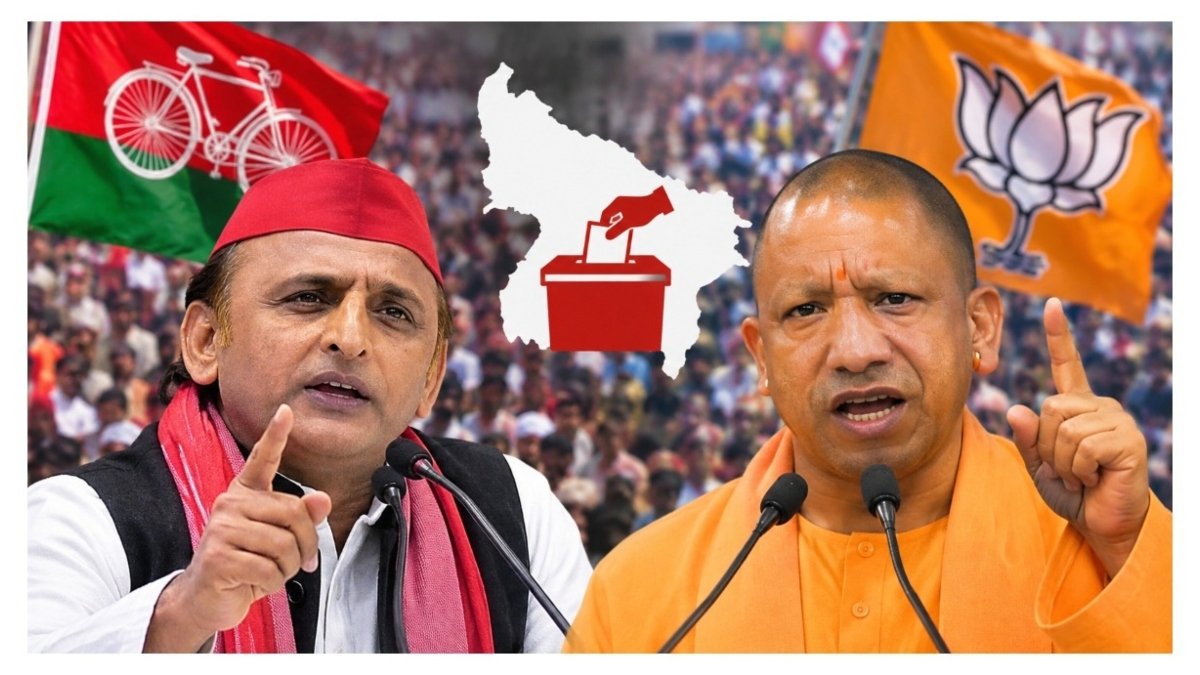
Lucknow, November 12: The political battle for Uttar Pradesh is intensifying ahead of the 2027 Assembly election, with Chief Minister Yogi Adityanath and Samajwadi Party (SP) president Akhilesh Yadav accelerating preparations to capture power in India’s most politically significant state.
While the BJP is strengthening its organisation, attracting opposition leaders and shortlisting candidates, Akhilesh is pursuing an equally aggressive strategy. Large crowds at his political rallies have generated enthusiasm among SP supporters, although the electoral impact remains uncertain.
BJP Targets Yadav Vote Bank
In a significant political development, Anil Yadav from Banda and former MP Arvind Kumar Chaudhary from Basti joined the BJP on November 11.
According to Aaj Tak, the leaders joined in the presence of Uttar Pradesh BJP president Pankaj Chaudhary, former state president Swatantra Dev Singh and Cabinet Minister Dayashankar Singh.
The development highlights the BJP’s efforts to attract leaders associated with communities traditionally considered loyal to the Samajwadi Party.
The Yadav community has long been an important pillar of the SP’s electoral support. However, the BJP appears determined to challenge this political equation by bringing influential community leaders into its fold.
Whether these defections translate into additional votes remains to be seen.
BJP Shortlists 209 Candidates, Allies May Get 60 Seats
The BJP has reportedly shortlisted 209 candidates for the upcoming Assembly election, according to media reports published on November 9–10, including Mint.
The names are awaiting approval from the party’s central leadership, suggesting that candidate selection has entered an advanced stage.
According to media reports, the BJP is considering allocating around 60 Assembly seats to its NDA partners for the 2027 Uttar Pradesh election. However, the seat-sharing arrangement has yet to receive official confirmation.
The alliance includes the Rashtriya Lok Dal (RLD), Apna Dal (S), Suheldev Bharatiya Samaj Party (SBSP) and Nishad Party.
These allies are also intensifying their activities on the ground, seeking to consolidate their respective support bases while directly challenging Akhilesh Yadav’s political influence.
Yogi Adityanath, meanwhile, appears firmly in election mode, with the ruling alliance focusing on organisational strength, local leadership and electoral arithmetic.
Akhilesh Moves Early, Announces Ayodhya Candidate
The Samajwadi Party is not far behind the BJP in its preparations.
Akhilesh Yadav has already begun making important electoral decisions. On August 5, 2026, he announced Pawan Pandey as the SP candidate for the politically significant Ayodhya Assembly constituency.
The early announcement gives the candidate additional time to strengthen his constituency-level organisation and connect with voters.
Political discussions also suggest that the SP is examining potential candidates from influential communities, including the Shakya community in western Uttar Pradesh.
The party is simultaneously attempting to attract former BJP MPs, MLAs and other leaders with established local influence.
Akhilesh’s strategy appears to be centred on identifying candidates with strong winning potential rather than depending exclusively on traditional caste loyalties.
Will Yadav Voters Reject Yadav Candidates?
An interesting dimension of the emerging political contest is the possibility of changing voter preferences within traditional caste groups.
In some constituencies, local political discussions suggest that sections of Yadav voters may not necessarily support candidates simply because they belong to the same community.
Such claims remain anecdotal and require constituency-level verification, but they raise questions about the effectiveness of conventional caste calculations.
For the SP, which has historically relied on strong Yadav-Muslim support, selecting locally acceptable candidates could prove crucial.
For the BJP, dissatisfaction with individual candidates could provide opportunities to attract voters beyond its established support base.
Ultimately, caste identity may remain influential, but candidate credibility, accessibility and local performance could become equally important.
Akhilesh Draws Crowds, BJP Relies On Organisation
The crowds attending Akhilesh Yadav’s rallies have become a major talking point in Uttar Pradesh’s political circles.
SP supporters view these gatherings as evidence of growing public enthusiasm. However, without comparable attendance data, it is difficult to establish whether his rallies consistently attract larger crowds than those addressed by BJP leaders.
The BJP continues to enjoy the advantages of incumbency, an established organisational network and an active alliance structure.
Akhilesh, on the other hand, is attempting to turn political mobilisation and public enthusiasm into constituency-level electoral strength.
Both parties face the same fundamental challenge: converting political support into actual votes.
Voters Confused As Political Equations Change
With leaders switching parties, candidates being identified early and alliance negotiations gathering pace, Uttar Pradesh’s political landscape is becoming increasingly complex.
The BJP is projecting confidence through candidate shortlisting and organisational preparations, while the SP is attempting to demonstrate that it is equally prepared to challenge the ruling alliance.
However, the electoral contest cannot be judged solely by rally attendance, defections or political announcements.
Local dissatisfaction, caste combinations, candidate popularity, alliance coordination and the performance of the incumbent government could all influence the outcome.
The biggest question is whether Akhilesh Yadav can convert his political mobilisation into enough Assembly victories to challenge Yogi Adityanath’s BJP-led alliance.
Both sides are preparing to win Uttar Pradesh, but neither can predict the final verdict. With voters still weighing their options, the 2027 election remains an open political contest.