
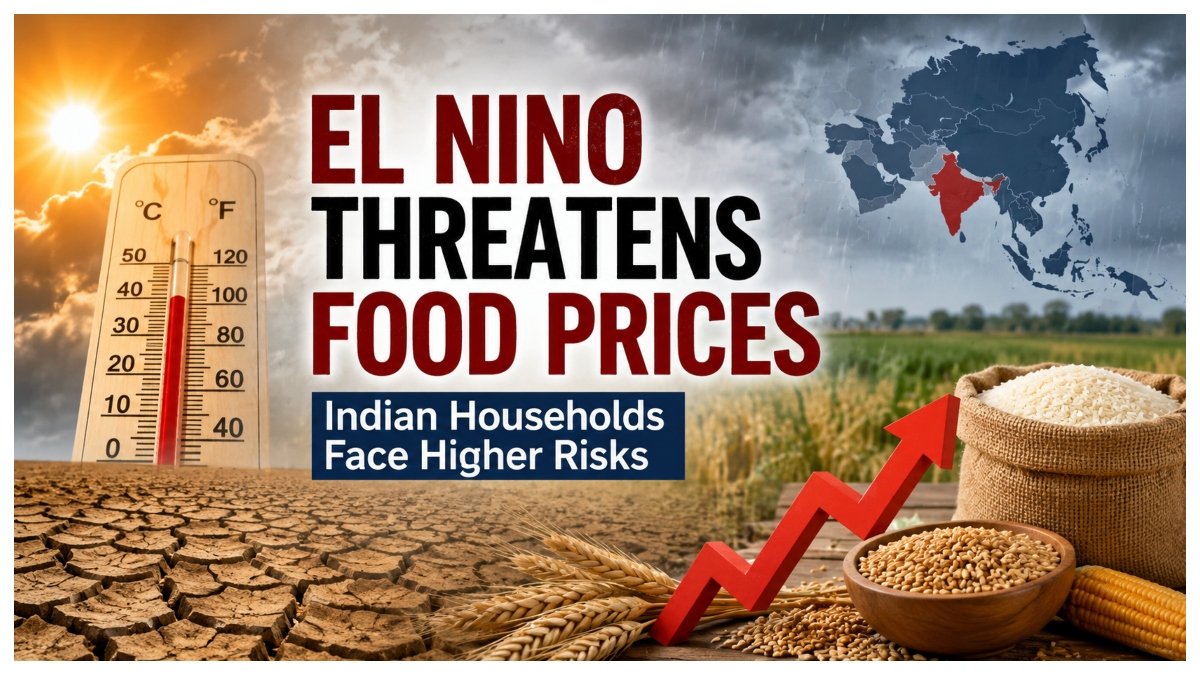
New Delhi: Households across India and several Asia-Pacific economies remain highly vulnerable to food price shocks as El Nino threatens rainfall, agricultural output and water availability, according to S&P Global Ratings.
India, Vietnam, Indonesia and the Philippines are among economies facing rising prices, with further weather-related supply disruptions potentially adding to household expenses.
Weather Risks
S&P said the El Nino period beginning in 2026 is expected to affect Asia-Pacific primarily through weaker rainfall and broader climate disruptions, although its overall macroeconomic impact could remain manageable.
The main risks include reduced agricultural production, higher food inflation, weaker hydropower generation and increased vegetation fires and haze.
South and Southeast Asia are among the regions most exposed to El Nino globally. Lower rainfall could push up food prices and disrupt industries heavily dependent on water.
India Buffers
India, however, has significant buffers against potential food supply shocks.
“Strong food and grain buffers for affected crops as of July 2026 are key to managing food shock,” S&P said, adding that authorities are coordinating with farmers at the district level to minimise crop losses.
Across Asia-Pacific, governments have expanded food buffer stocks, improved import planning and strengthened market management mechanisms.
Investments in irrigation, reservoirs and water governance have also increased resilience against periods of weaker rainfall.
Agriculture Exposure
S&P said countries where agriculture accounts for a larger share of economic output and food takes up a greater portion of household spending would face greater risks from a severe El Nino.
Agriculture’s contribution to economic activity is gradually declining across the region, helping reduce the potential macroeconomic impact.
Lower hydropower generation remains another significant transmission channel.
Inflation Concern
The Reserve Bank of India has also flagged deficient and uneven south-west monsoon rainfall amid El Nino conditions as a risk to agriculture and rural demand.
The central bank has projected retail inflation at 5 per cent for FY27.
However, it expects proactive supply management and adequate foodgrain stocks to provide some protection against weather-driven inflation.
The World Meteorological Organisation recently said strong El Nino conditions were developing and could intensify between August and October, potentially bringing above-normal temperatures and powerful weather events worldwide.