
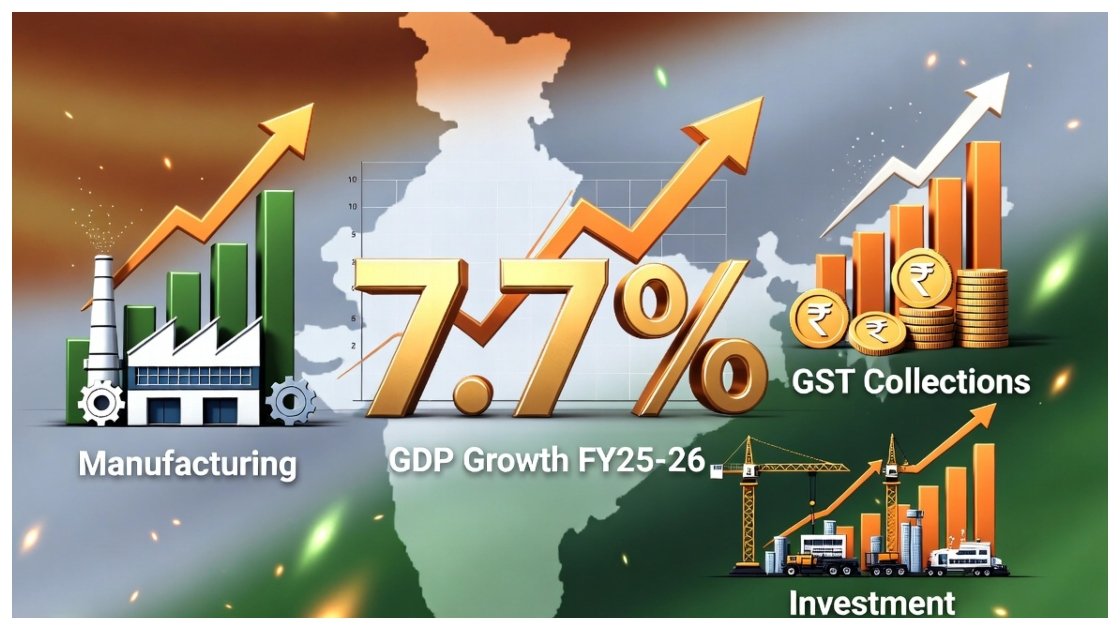
New Delhi: India’s economy continued to perform strongly in FY2025-26, growing by 7.7%, making it the fastest-growing major economy in the world.
During the January-March quarter (Q4 FY26), real GDP growth improved to 7.8%, compared with 7.0% in the same quarter a year earlier.
The growth was supported by higher manufacturing output, a strong services sector, rising consumer spending, and increased investments.
Manufacturing and services stay strong
India’s manufacturing sector continued to expand steadily.
The HSBC India Manufacturing PMI stood at 54.2 in June 2026, marking the 37th consecutive month above the 50-point level, which indicates expansion in business activity.
The services sector also remained strong.
The HSBC Services PMI rose to 59.8 in May 2026, up from 58.8 in April, recording its fastest growth since November 2025.
Higher customer demand, new orders, export business, and job creation helped drive growth in the services sector.
Industrial production and investment improve
India’s Index of Industrial Production (IIP) increased by 5.1% in May 2026, the highest level in five months.
Manufacturing output grew 5.5%, while electricity and gas production rose 9.9%.
Motor vehicles, electrical equipment, and basic metals were among the best-performing industries.
Capital goods production jumped 12.9%, showing that investment activity is gaining strength.
Government boosts infrastructure spending
The government spent ₹2.51 lakh crore on capital expenditure during the first two months of FY2026-27.
This was around ₹29,650 crore higher than the same period last year.
Major investments were made in railways, roads, defence, telecommunications, and other infrastructure projects.
Higher government spending is expected to benefit sectors such as construction, steel, cement, and transportation in the coming months.
Tax collections remain healthy
Strong economic activity also helped government tax collections.
Gross GST collections rose 13.9% year-on-year to nearly ₹1.95 lakh crore in June 2026.
Meanwhile, Net Direct Tax collections increased 14.64% to ₹5.21 lakh crore by June 17, strengthening the government’s revenue position.
Lower crude oil and fertiliser prices are also expected to help the government manage its spending plans more effectively.
High-frequency indicators show positive trend
Several high-frequency economic indicators also pointed to continued growth.
In May 2026, e-way bill generation increased 10.9%, electricity demand rose 11.2%, and cargo handled at ports grew 6.6%.
Vehicle sales also remained strong between April and June 2026.
A record 26.11 lakh vehicles were sold in April, while sales increased by around 10% in May. Demand remained healthy in June across passenger vehicles, SUVs, electric vehicles, two-wheelers, and commercial vehicles.
Rural vehicle sales also grew 7.8%, showing improving demand in rural India.
Growth outlook remains positive
Strong domestic demand, rising investments, higher infrastructure spending, and healthy tax collections continue to support India’s economic growth.
Despite global uncertainties, the latest economic indicators suggest that the country’s growth momentum is likely to remain strong in the coming months.