
New Delhi: Losing access to discounted Russian crude may increase India’s oil procurement costs, but a prolonged rise in global crude prices to $100 a barrel could pose a much greater threat to the economy, according to an expert assessment cited by ANI.
The distinction has gained importance amid geopolitical uncertainty and pressure on countries continuing to purchase Russian energy.
Discount Fades
Russian oil provided substantial savings to Indian refiners after the Russia-Ukraine conflict disrupted global energy trade.
Discounts on Russian crude had once widened to around $15-$20 per barrel, making Moscow an attractive supplier for Indian refiners.
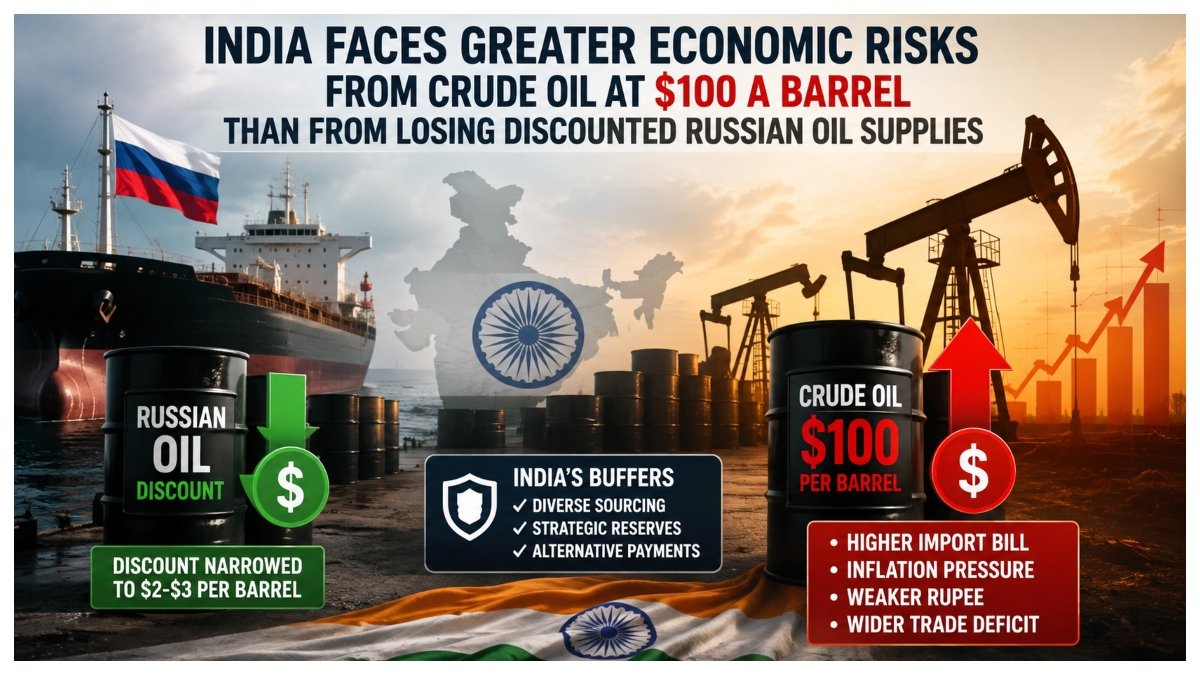
That advantage has since diminished considerably. According to the assessment cited by ANI, the discount has narrowed to around $2-$3 per barrel.
India spends nearly $150 billion annually on crude imports, while savings generated from the current Russian oil discount are estimated at about $2-$3 billion a year.
Replacing those barrels with supplies from other producers would therefore increase costs, but the impact could remain relatively manageable.
Supply Options
India’s diversified sourcing strategy provides another cushion against potential disruptions.
The country buys crude from more than 40 nations, including suppliers across the Middle East, Africa and the US, giving refiners greater flexibility to replace disrupted shipments.
Strategic petroleum reserves and commercial inventories can also provide protection against short-term supply shortages.
Bigger Risk
The more serious challenge would emerge if international crude prices climb towards $100 a barrel and remain elevated.
Every $10 increase in the average price of India’s crude import basket could add roughly $15 billion to its annual oil import bill, according to the ANI-cited assessment.
Such an increase would dwarf the savings currently generated from discounted Russian crude.
Economic Impact
Persistently expensive oil could widen India’s trade deficit and exert pressure on the rupee, while also feeding into domestic inflation.
Higher energy costs can increase freight, transportation and manufacturing expenses, eventually affecting businesses and consumers.
India has also developed alternative payment mechanisms, including rupee-based trade and bilateral settlement arrangements, to reduce exposure to geopolitical disruptions.
While losing Russian discounts could make crude procurement somewhat more expensive, the bigger macroeconomic danger for India would be a prolonged global oil price shock near or above $100 a barrel.