
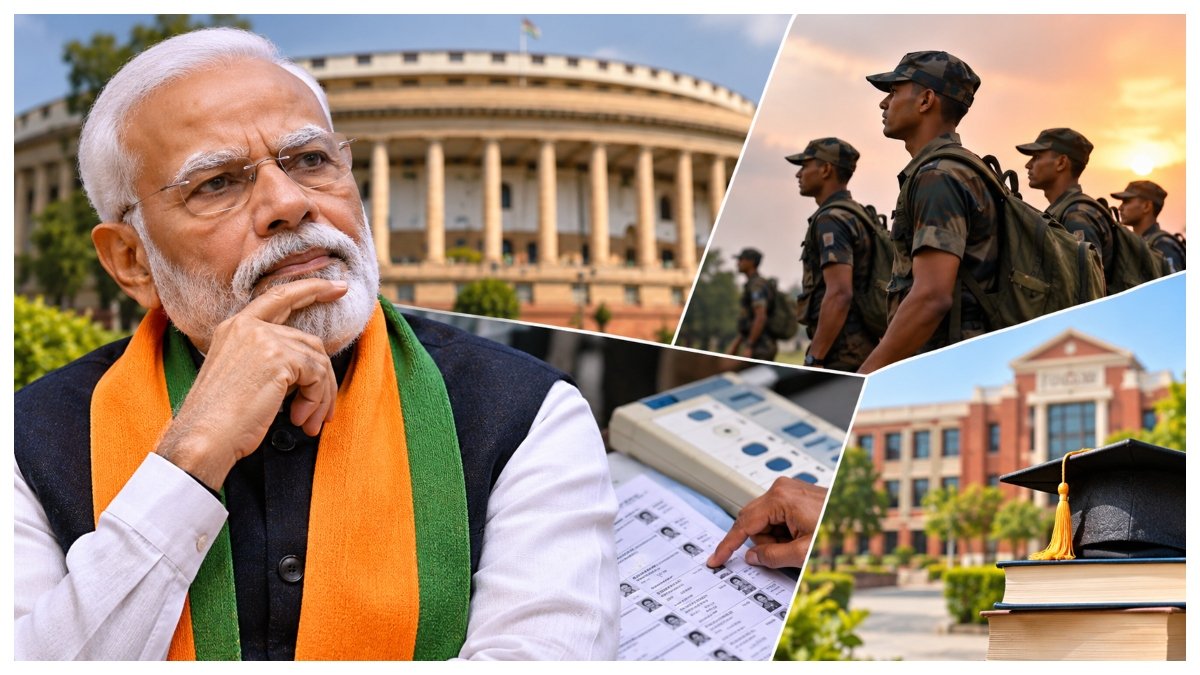
New Delhi: Is the BJP-led government becoming more responsive to public concerns, or is mounting political pressure forcing a rethink of controversial decisions? Recent developments involving electoral roll revisions, the Agnipath recruitment scheme and University Grants Commission (UGC) regulations have revived this debate.
While authorities describe these changes as administrative improvements and responses to feedback, critics question whether political considerations are influencing policy decisions.
Electoral Revisions
The Election Commission’s Special Intensive Revision (SIR) exercise has faced criticism over voter deletions, documentation requirements and enrolment procedures.
The Commission has withdrawn a controversial Form 6 declaration, introduced additional enrolment measures and extended revision deadlines in several states.
Opposition parties argue that these changes validate their concerns about voter exclusion.
However, the Election Commission is an independent constitutional authority, and its decisions cannot automatically be linked to the BJP government.
Agnipath Changes
The government’s November 4 decision to extend Agniveers’ engagement by two years has renewed scrutiny of the Agnipath recruitment scheme introduced in 2022.
Under the revised arrangement, recruits not initially selected for permanent service can continue for another two years before becoming eligible for regular enrolment, subject to selection criteria.
The government maintains that the modification follows performance assessments and feedback from the armed forces.
Critics, however, question whether concerns about job security and military retention were adequately considered during the scheme’s introduction.
UGC Review
The UGC’s 2026 equity regulations have also triggered controversy over discrimination safeguards in higher education.
Following the Supreme Court’s stay in January, the Centre informed the court on November 5 that it was considering a review committee.
The government must balance demands for stronger anti-discrimination protections with concerns about fairness and implementation.
Importantly, no final withdrawal has been announced.
Political Pressure
These developments have intensified questions about the government’s approach to contentious policies.
Opposition parties view the revisions as signs of growing public resistance, while the government presents them as evidence of consultation and administrative flexibility.
Upcoming state elections add another political dimension, with the BJP seeking to balance competing social interests.
Leadership Challenge
The central question remains whether these decisions reflect political retreat or genuine policy correction.
Revising policies can strengthen governance, but repeated changes also invite scrutiny of initial planning.
For the BJP, explaining the reasons behind these decisions may prove as important as the revisions themselves.